
Below are the details for the minimum and maximum allowable values in both digital inputs and outputs and analog inputs for current and voltage, as well as power consumption of the wRemote.
Parameter |
Condition |
Minimum |
Maximum |
Units |
Input Voltage |
|
10/13(*) |
30 |
Vdc |
Average Current (**) |
wRemote @ 24 Vdc wRemote @ 12 Vdc |
|
15 25 |
mA |
Maximum Current (**) |
wRemote @ 24 Vdc wRemote @ 12 Vdc |
|
20 30 |
mA |
(*) Analog outputs will require 13V power supply to deliver 10V output
(**) This values apply for wRemote-1000-CN, wRemote-3005-ND and wRemote-5005-ND
Parameter |
Minimum |
Maximum |
Units |
Frecuency |
2.4000 |
2.4835 |
GHz |
Channels |
|
16 |
|
Channel Separation |
|
5 |
MHz |
Tx Power |
+10 |
+20 |
dBm |
Sensitivity |
-104 |
dbm |
In order to activate the digital inputs the voltage must be applied externally. This power supply has to share the GND terminal with the device power supply. If necessary you can use the same source used to power the wRemote. The input type is Sinking and accepts sensors or PNP sourcing type devices.
Parameter |
Minimum |
Maximum |
Units |
Activated Input |
3.5 |
25 |
Vdc |
Input Impedance |
2 |
KΩ |
|
Count frequency* |
|
1 |
kHz |
*Check "Instalation" section to see models with count feature.
Below are two examples of how to connect an input either directly from the same source that powers the device or as an external source where it is clear that they must share the common terminal.
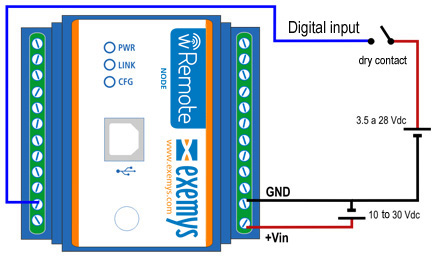
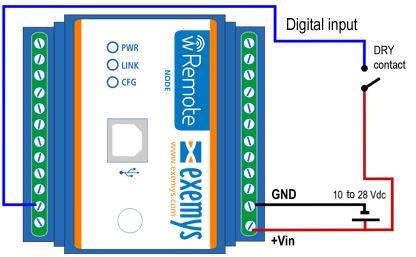
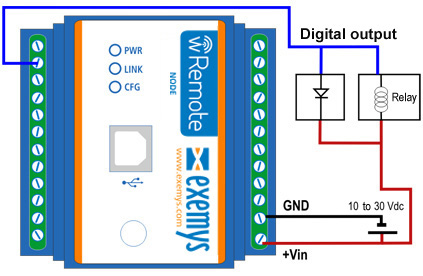
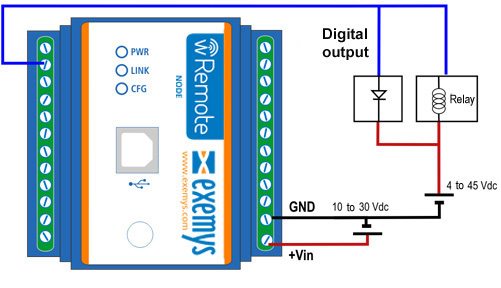
The digital outputs are of the open collector type. The load to be connected must be supplied with an external voltage source. They have to share the GND terminal to the device power supply. If necessary you can use the same source that is used to power the device. The output type is NPN Sourcing (Open Collector).
Parameter |
Minimum |
Maximum |
Units |
Voltage Support |
|
45 |
Vdc |
Current |
|
50 |
mA |
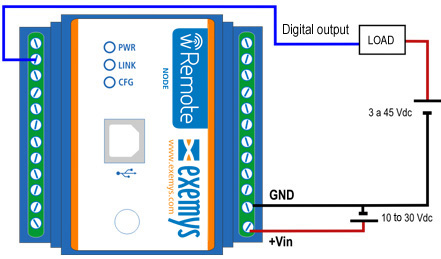
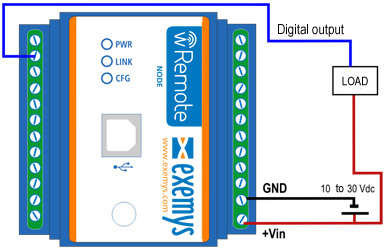
When digital output is used to drive a relay coil, it is necessary to add a protection diode to the connection in order to prevent damage to the device output. This must be connected in reverse. This means the anode connects to the output terminal of the equipment and the cathode to the positive terminal that feeds the relay. The relay must be powered using an external power source, sharing the GND terminal with the device supply. If necessary the same source that feeds the wRemote can be used. Shown in the image below is the connection of a relay to a digital output of the device.
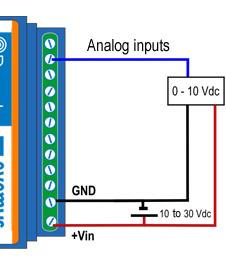
The analog inputs are referenced to the GND device terminal so that the source used to power the sensor must share with the GND device terminal.
Parameter |
Value |
Units |
Full Scale |
10.00 |
Vdc |
Precision |
0.01 |
Vdc |
Input Impedance |
10.7 |
KΩ |
Below are two example of how to connect an analog input voltage for both a simple source and for an independent source.

Parameter |
Value |
Units |
Full Scale |
20.00 |
mA |
Precision |
0.01 |
mA |
Shunt |
68 |
Ω |
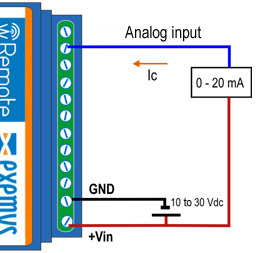
Below are two examples where you can see the connection of a 4-20mA sensor sharing power with the device for passive sensors or active sensors with an independent source.

The analog outputs refer to the GND device terminal.
The analog outputs in the voltage mode have the limitation that we place the charge on should not be less than 500R. If we use the full range of the output voltage then the output can deliver a maximum of 20mA.
You should always follow VoutMAX / LOAD <= 20mA.
Type of connection:
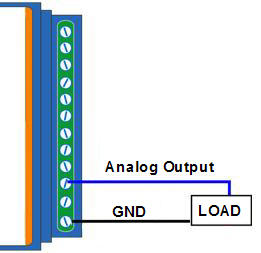
In this case the maximum charge that we can connect an analog output in the current mode depends on the power supply voltage, as this should be enough to deliver up to 20mA to the load.
Power source (V) |
Max. Load (Current Mode) |
13 |
650R |
15 |
750R |
24 |
1,2K |
30 |
1,5K |
Connection form
2021-11-12